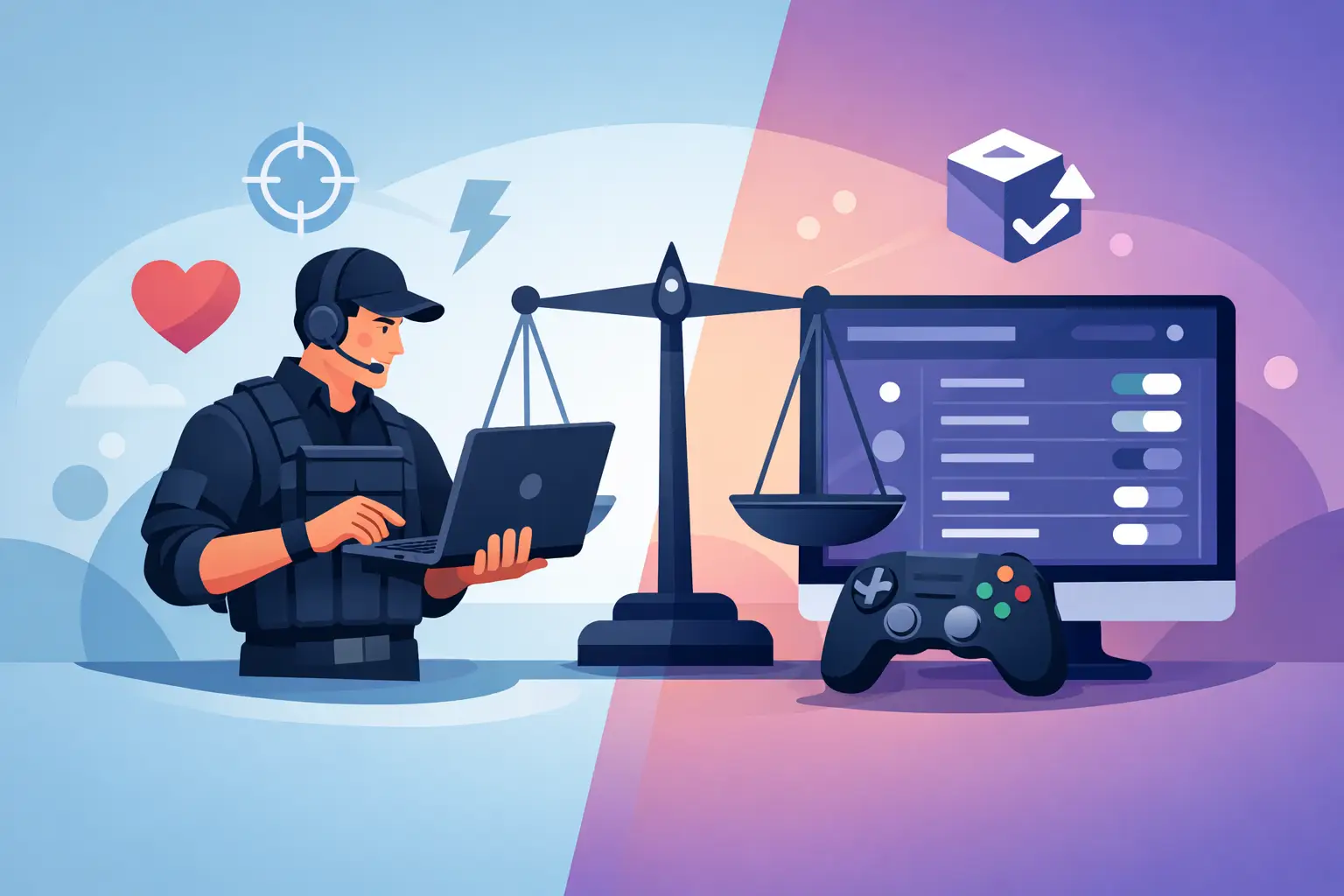
The wrong tool wastes time fast. You load in expecting money edits, teleport, ESP, or god mode, and instead get a barebones trainer that only freezes health and ammo. That is why trainer vs mod menu matters. If you care about speed, feature depth, and staying in control, you need to know what each one actually does before you inject anything.
For most PC gamers, the difference is simple at first glance. A trainer usually focuses on toggles and value edits for a specific game, often in single-player. A mod menu is broader, more interactive, and built around an in-game interface with deeper control. But that surface-level answer misses the real point. The right choice depends on the game, the anti-cheat pressure, the feature set you want, and how much friction you are willing to tolerate.
Trainer vs mod menu: the core difference
A trainer is usually the faster, lighter option. You launch it, attach it, hit hotkeys or a small external panel, and start changing health, ammo, money, XP, cooldowns, or item counts. Trainers are built for direct utility. They are there to get results without making you manage a full in-game system.
A mod menu is closer to a full control panel inside the game. Instead of a few hotkeys, you usually get categories, submenus, and a wider list of functions. Think teleportation, noclip, unlock systems, vehicle spawning, session control, ESP, griefing tools, anti-kick features, and more. In a trainer, you edit values. In a mod menu, you often reshape the session.
That distinction matters because expectations matter. If you want simple progression boosts in a single-player RPG, a trainer can be enough. If you want broader power in an open-world sandbox or online environment, a mod menu is usually the better fit.
When a trainer makes more sense
A trainer wins when you care about speed and simplicity. You want the game running, you want god mode or fast XP, and you do not want to sort through thirty tabs to find it. That is where trainers still hit hard.
Single-player titles are the clearest example. If your goal is infinite ammo, skill points, inventory edits, or freezing mission timers, a trainer is often the cleanest answer. It is lighter, easier to learn, and less cluttered. For newer buyers, that matters. Not everyone wants a menu packed with options they will never touch.
There is also a workflow advantage. Good trainers tend to be direct. Launch, inject, toggle, play. If the software is maintained well, that low-friction setup is a real selling point. You are not wasting time troubleshooting a bloated interface when all you needed was cash, XP, and a few quality-of-life options.
That said, trainers do have limits. They are usually narrower in scope. They may not give you session-level control, advanced ESP, or interaction-heavy features. If your needs grow, the trainer can start feeling small fast.
When a mod menu is the better weapon
A mod menu is built for users who want more than stat edits. It is for the player who wants control inside the game, not just around it. If a trainer changes numbers, a mod menu changes the experience.
That is why mod menus dominate in games with larger sandboxes, persistent online sessions, or heavy social interaction. If you want to teleport across the map, spawn assets, manipulate lobbies, protect yourself from kicks, or run ESP while moving through an active multiplayer session, a menu is the stronger format. You get more features, more flexibility, and usually a better interface for using them mid-match.
This is also where premium products separate themselves from random public builds. A strong mod menu is not just feature-rich. It is stable, updated, and designed for quick access under pressure. That matters more in online games where anti-cheat shifts, patches hit without warning, and outdated tools get people flagged.
Forza Horizon 6 is a good example of why menus get attention right now. In a game like that, players are not only looking for money or XP. They want broader control, faster access to game-changing options, and a cleaner in-game workflow. A proper menu format simply handles that better than a stripped-down trainer.
Setup, usability, and why convenience matters
A lot of trainer vs mod menu debates ignore the setup question. That is a mistake. Buyers do not just compare features. They compare friction.
A basic trainer can feel easier because it often has fewer moving parts. Open it, bind a few keys, and go. But some trainers are messy, outdated, or built with weak loaders that create more headaches than the software is worth. So simplicity only helps if the delivery is solid.
Mod menus can look more complex, but a good custom loader changes that. If the injection process is standardized and the menu is maintained, the user experience can be just as fast. In some cases, it is better, because once you are in-game, everything is organized in one place instead of scattered across hotkeys you have to memorize.
For less technical buyers, this matters a lot. Nobody wants to spend more time setting up than playing. Clean injection, stable updates, and a menu that works the first time are not extras. They are the baseline.
Safety and detection risk
This is where people make bad assumptions. They think trainers are automatically safer because they are simpler, or that mod menus are automatically riskier because they do more. That is not the real split.
Detection risk has more to do with how the tool is built, how often it is updated, and how well it keeps pace with anti-cheat changes. A sloppy trainer can be riskier than a well-maintained mod menu. A dead public menu can be worse than a private trainer with active support. Format matters less than maintenance.
What does matter is your use case. If you are in a stricter online environment and using aggressive features, your exposure goes up. Session manipulation, griefing utilities, and high-visibility actions naturally carry more attention than quiet stat edits in a solo session. That does not mean you avoid menus. It means you choose software that is actively maintained and use features with some discipline.
That is the difference between amateur and serious buyers. Serious buyers do not just ask what features exist. They ask how often the cheat is updated, how the injection workflow is handled, and whether the provider treats anti-cheat pressure as an ongoing job.
Feature depth decides the winner
If you compare a trainer and a mod menu on pure feature depth, the mod menu usually wins. There is no point pretending otherwise. It tends to offer more categories, better in-session control, and more freedom to adapt on the fly.
But feature depth is not always the same as value. If you only need infinite health, one-hit kills, unlimited resources, and a money editor, paying for a huge menu can be overkill. More options do not help if you never use them.
This is why the best choice depends on your actual pattern of play. Story-driven games, grind-heavy progression systems, and offline content often pair well with trainers. Social games, open-world lobbies, and multiplayer-focused titles usually lean toward menus. The more dynamic the environment, the more useful a menu becomes.
That is also why serious storefronts offer both formats across different games. Different titles call for different tools. For some, a trainer is the right answer. For others, a premium mod menu with an undetected loader is the only format that makes sense.
Which one should you buy?
If your priority is quick edits, simple controls, and low clutter, go with a trainer. It is cleaner and usually easier to use for straightforward single-player advantages.
If your priority is range, in-game control, and stronger utility in online or sandbox-heavy games, go with a mod menu. You get more power where it counts.
The real answer is not trainer or mod menu in a vacuum. It is trainer or mod menu for a specific game, a specific anti-cheat environment, and a specific goal. Buyers who understand that waste less money and get better results.
One more thing. Do not buy based on screenshots and feature spam alone. Buy based on maintenance, injection quality, and whether the tool is built for the way you actually play. DarkOffset’s audience already knows the standard: undetected, updated, ready to use. That is the level that matters.
Pick the format that matches the game, not your guess. The better the fit, the less time you spend troubleshooting and the more time you spend running the lobby.